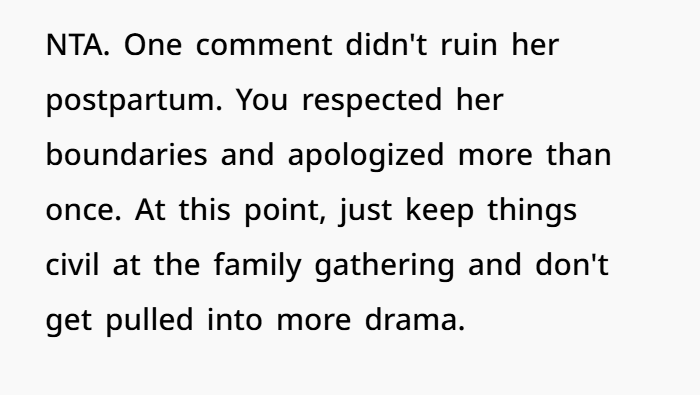
‘AITA for ruining my brother’s girlfriend’s postpartum?’

What started as an exciting time for one family soon turned into a stressful family dispute. The problem involved postpartum boundaries, Facebook comments, family relationships, and how much support a new mother should expect after giving birth.
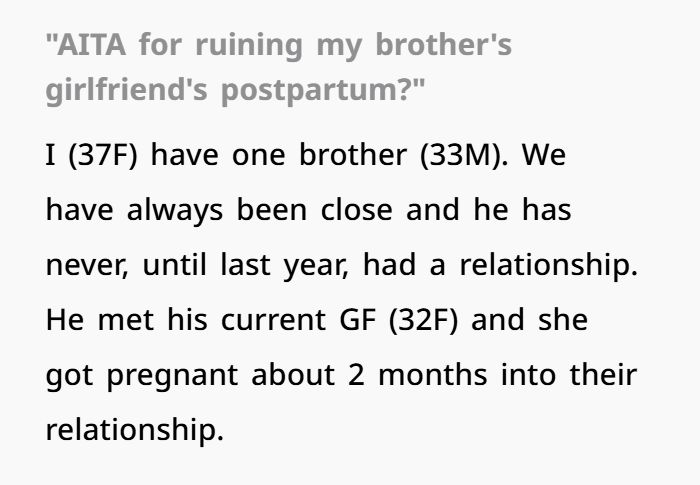
A 37-year-old woman said she had always been close to her 33-year-old brother. Then he entered his first serious relationship with a 32-year-old woman.


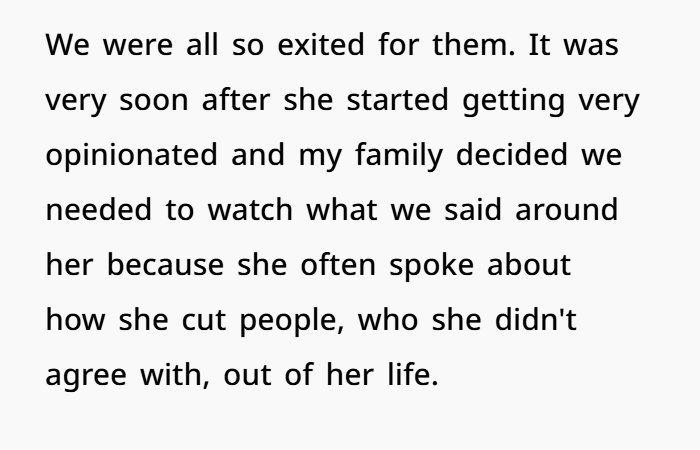
About two months into their relationship, the couple found out they were expecting a baby. Of course, the family was excited about the news.
But as the pregnancy went on, things started to feel different.
According to the sister, her brother’s girlfriend often talked about cutting people out of her life when they disagreed with her. Because of that, family members became careful around her. They felt like they had to watch what they said to avoid upsetting her.
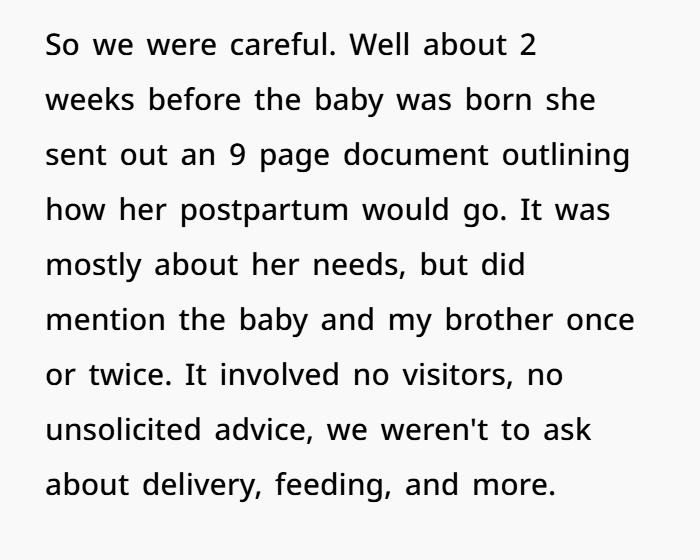
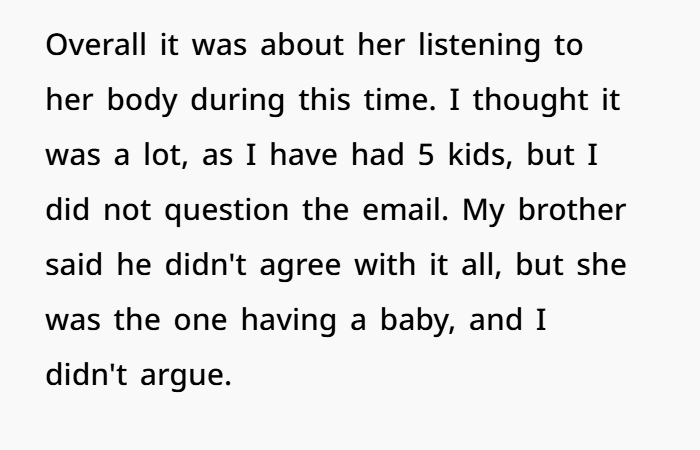
Then, two weeks before the baby was born, the girlfriend made her postpartum boundaries very clear.
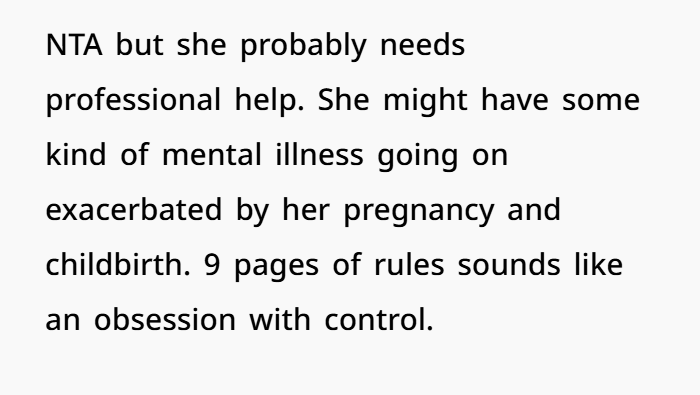
She sent family members a nine-page document explaining what she expected after giving birth. The rules included no visitors unless they were invited, no parenting advice unless she asked for it, and no questions about the delivery or how the baby was being fed.
The sister, who has five children herself, thought the list was pretty long. Still, she didn’t argue about it.
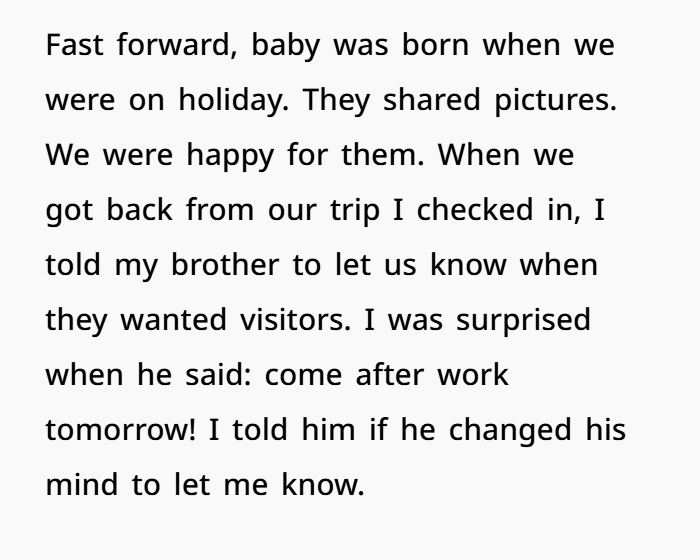
The baby arrived while the family was away on vacation. The new parents shared photos, and when the sister came home, she told her brother that he should decide when they were ready to have visitors.
Her brother invited the family over the very next day.
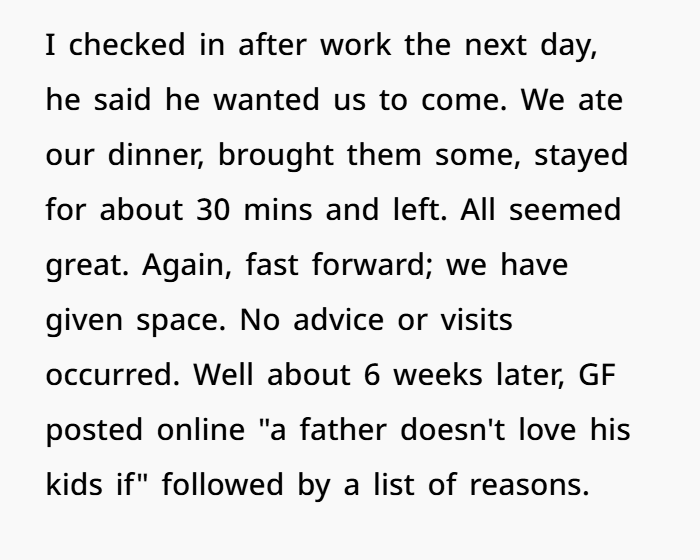
They brought dinner, stayed for about 30 minutes, and then left. Nothing seemed to go wrong during the visit.
For the next six weeks, the family says they continued to respect the new parents’ postpartum boundaries.
Then a Facebook post changed everything.
The girlfriend shared a public post saying that “a father doesn’t love his kids if…” followed by a list of behaviors.
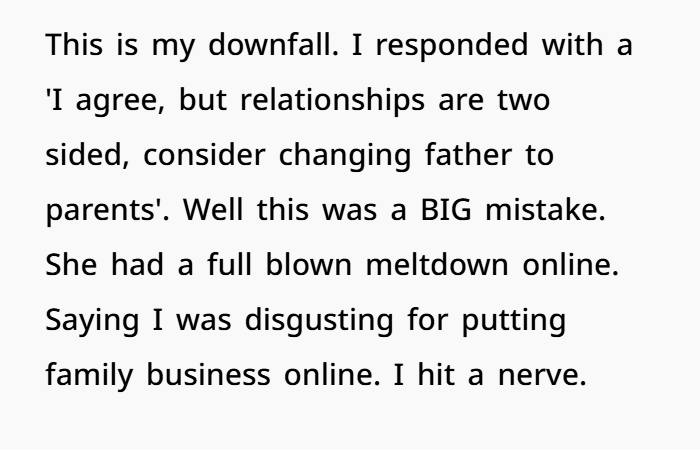
The sister commented on the post. She said she agreed with the main idea, but suggested changing “father” to “parents.” Her point was that parenting and relationships go both ways.
That one Facebook comment quickly turned into a much bigger family conflict.
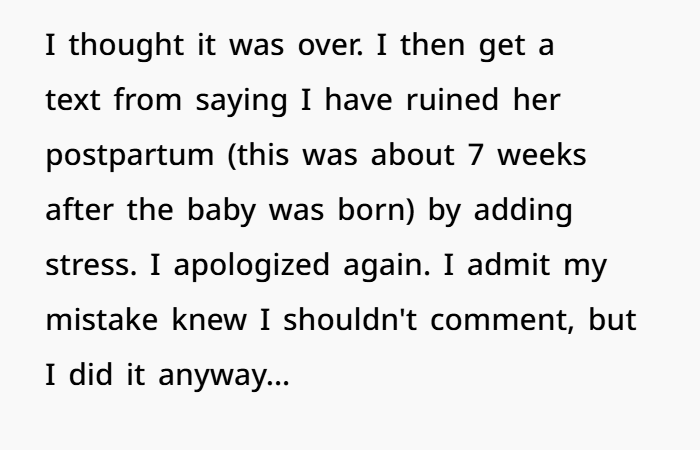
The girlfriend accused the sister of putting private family matters on social media. She later said the comment had “ruined her postpartum” because it caused stress she didn’t need during that time.
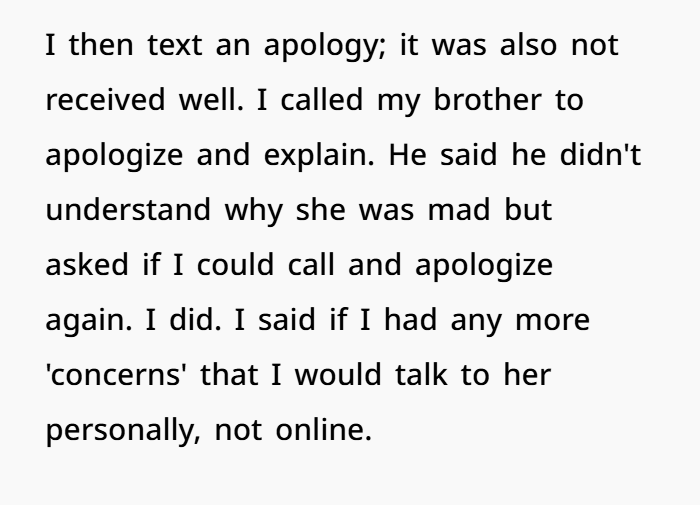
The sister apologized through text. She also spoke with her brother and later called his girlfriend to apologize again.
She promised that if she had concerns in the future, she would talk about them privately instead of commenting publicly.
But even after another apology, the issue didn’t go away.
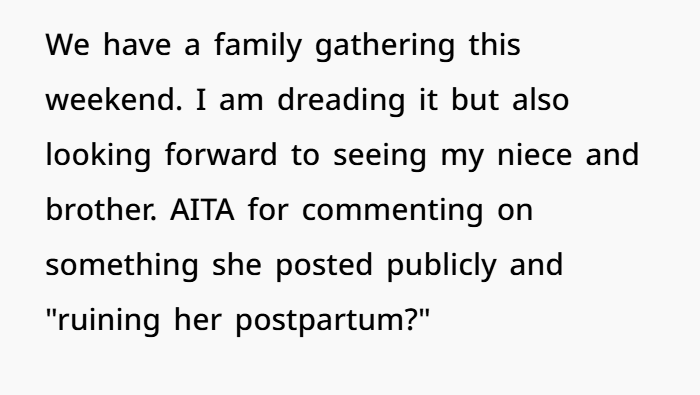
Now a family gathering is coming up, and the tension is still there. The big question is whether that Facebook comment truly crossed a serious postpartum boundary, or if a small disagreement grew into a much bigger family problem.
more info on reddit
The biggest question here is not simply whether the sister should have made that Facebook comment. It’s whether one comment was serious enough to reasonably be blamed for “ruining” someone’s entire postpartum experience.
Those are two very different things.
The timing matters too. Seven weeks after giving birth is still part of the postpartum period.
The American College of Obstetricians and Gynecologists says postpartum care should continue through the first 12 weeks after birth. It does not simply end after the traditional six-week checkup.
This time is often called the “fourth trimester.” A new mother may still be physically recovering while also dealing with little sleep, feeding the baby, hormonal changes, new responsibilities, tiredness, stress, and the emotional adjustment of becoming a parent.
Because of all that, a disagreement that might seem small at another time can feel much bigger during those early weeks.
The American College of Obstetricians and Gynecologists also says postpartum care should focus on a mother’s physical, social, and emotional well-being. Recovery is different for every person. There isn’t one exact point when every new mother suddenly feels “back to normal.”
With that in mind, the girlfriend’s postpartum boundaries make sense.
She wanted relatives to avoid unexpected visits. She didn’t want questions about childbirth or feeding, and she didn’t want parenting advice unless she asked for it. She also wanted to decide when visitors could come over.
Some families might think a detailed postpartum plan is a bit much. But having a long list of rules does not automatically mean the boundaries themselves are unreasonable.
Research also shows that support after childbirth matters.
One study involving postpartum mothers found that practical help was important for both physical and emotional recovery. Partners and family members often played a major role in providing that support.
More recent research using postpartum data from Illinois also found a strong link between low social support and reported symptoms of postpartum depression.
That doesn’t mean relatives have to agree with every request a new parent makes. But it does show why postpartum stress, maternal mental health, emotional support, and family communication should be taken seriously.
Research available through PubMed found something similar. Women who reported low practical support along with low emotional support from their partners had much higher odds of reporting postpartum depressive symptoms than women with strong support.
Other studies have also found that social support can help protect maternal mental health after childbirth.
Still, that research does not automatically settle this family dispute.
According to the sister, the family followed the boundaries they were given.
They didn’t show up without permission. Her brother invited them to visit. They checked before coming, brought food, stayed for a short time, and then gave the new parents space for several weeks.
If that account is accurate, this wasn’t a case of relatives repeatedly ignoring the couple’s postpartum plan.
The conflict started after the girlfriend posted something publicly on social media.
And that creates a different issue: what happens when a public Facebook post touches on a private family disagreement?
A public post can invite comments, but that doesn’t mean every response from a relative will feel harmless.
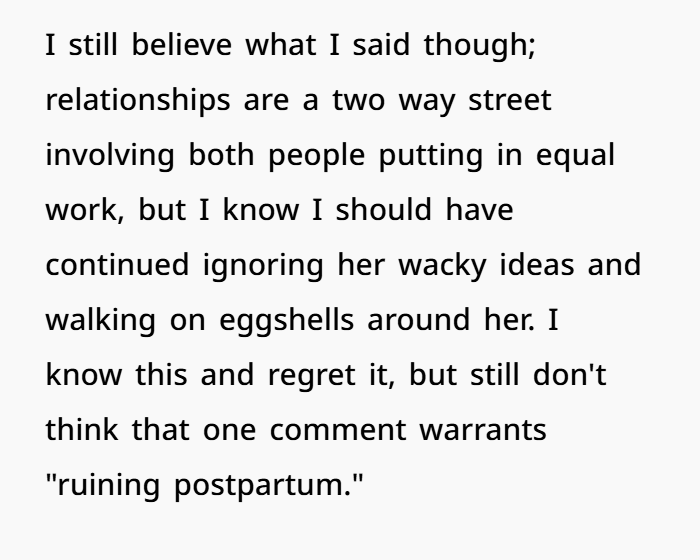
The sister said parenting and relationships require effort from both people. On its own, that statement was not abusive or threatening.
But the context changes things.
The girlfriend’s post specifically talked about fathers. The person responding was her partner’s sister. So when the sister suggested changing “father” to “parents,” the girlfriend may have felt that she was defending her brother or quietly criticizing her.
The words may have sounded general, but because of their family relationship, they could easily have felt personal.
At that point, figuring out who technically had the right to comment becomes less useful than understanding how family arguments grow.
Relationship researchers have studied how criticism can lead to defensiveness and make disagreements worse. The Gottman Institute describes a pattern where one person feels attacked, becomes defensive, and responds in a way that creates even more tension.
That doesn’t tell us who was right in this case. But it does help explain how one short Facebook comment could turn into a much bigger family conflict.
The sister seems to understand part of that herself.
She still believes her basic point was fair: healthy relationships require effort from both people. But she also admits that making the comment publicly wasn’t necessary.
More importantly, she apologized several times.
She apologized by text, spoke with her brother, called his girlfriend directly to apologize, and apologized again after being told that her comment had caused postpartum stress.
She also promised that any future concerns would be discussed privately.
Once that happened, the question changed.
It was no longer just about whether the Facebook comment was inappropriate. The bigger question became whether repeated apologies should eventually create a way for the family to move forward.
There is another important point here.
Research shows that stress, conflict, and a lack of support can affect women during pregnancy and the postpartum period. But that research should not be used to claim that any upsetting argument can medically be blamed for “ruining postpartum.”
Studies have found links between stress, family conflict, social support, and depressive symptoms. But from this story alone, nobody can diagnose the girlfriend’s mental health or say that one Facebook comment caused a postpartum mental health problem.
For example, one study that followed more than 1,000 women found that social conflict and social support were each connected with depressive symptoms during pregnancy. Other postpartum research has repeatedly found links between stronger social support and better maternal mental health.
But an association is not the same as proving that one specific event caused someone’s emotional state.
That difference matters.
Postpartum depression, postpartum anxiety, maternal mental health, and emotional recovery after childbirth are serious medical and psychological issues. They shouldn’t become labels used to decide who won a family argument.
Nothing in this story proves that the girlfriend has a postpartum mental health condition. Being extremely angry would not be enough to reach that conclusion either.
If a new parent experiences ongoing depression, severe anxiety, overwhelming distress, or other worrying changes, those symptoms deserve professional attention rather than guesses from family members.
The bigger problem here seems to have started long before that Facebook comment.
According to the sister, relatives were already careful about what they said because they worried that disagreement could lead to being cut out of the girlfriend’s life.
Then came the nine-page postpartum document, which made it even clearer that communication would need to stay within carefully set boundaries.
For a while, the family followed those expectations.
Then the sister challenged something the girlfriend posted publicly. Her response may have been mild, but it disturbed an already fragile family situation. The disagreement quickly became much larger.
Seen that way, the Facebook comment may have been the trigger, rather than the whole cause of the conflict.
Now there is another family gathering coming up, and what happens there could matter far more than the original Facebook exchange.
If the sister wants to stay close to her brother and niece, trying to prove that the girlfriend overreacted probably won’t help.
She has already apologized several times. Arguing again about whether a public Facebook post was “fair game” could simply bring the same fight into the family gathering.
A calmer approach may work better.
She can keep things polite, avoid comments about parenting, and allow her brother and his girlfriend to decide how much interaction they are comfortable with.
At the same time, respecting postpartum boundaries doesn’t mean accepting unlimited responsibility for another adult’s emotions.
There is a big difference between saying, “That comment was unnecessary and caused stress, so an apology was appropriate,” and saying, “That one comment ruined weeks or months of postpartum recovery.”
Based on the information provided, the situation seems to fall somewhere between the sister doing nothing wrong and committing a serious offense.
She made a public comment that probably would have been better kept private, especially because the family relationship was already tense.
The girlfriend also had every right to dislike the comment and ask that private family concerns stay off social media.
But the sister apologized several times, agreed to handle future concerns privately, and had reportedly respected the couple’s postpartum boundaries before the argument.
With those facts in mind, blaming one Facebook interaction for the condition of an entire postpartum period seems out of proportion unless there is much more to the story.
At this point, the real problem isn’t the Facebook comment anymore.
It’s whether this family can find a healthier way to communicate.
The new mother should be able to set reasonable postpartum boundaries without every disagreement putting family relationships at risk. At the same time, relatives should be able to admit when they made a mistake, apologize, and move forward without one bad decision defining their place in the family forever.
That will matter much longer than one comment sitting on a Facebook timeline.
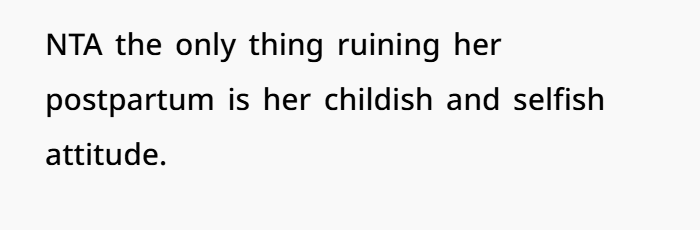
Here’s what people had to say to OP:
scrapples000 said:
YourGeniusIzShowing said:
Status-Slip9801 said:

Brave-Bad-5338 said: