‘AITA for telling my sister we’re strangers since she eloped and broke all contact with us?’

Nine years is a long time. Long enough for someone you love to slowly start feeling like a stranger.
When he was 18, a young man watched his older sister run away with her boyfriend. Their immigrant parents strongly disapproved of the relationship. He didn’t feel the same way. He had no problem with who she wanted to be with.


But his sister didn’t just leave home and get married without her family’s approval. She completely disappeared from their lives.
He tried to contact her, but nothing worked. She blocked messages on different platforms. He even tried reaching her through her friends, but that didn’t help either.
All her friends could tell him was that she seemed happy.
Back home, things were much harder. His parents were devastated by their daughter’s disappearance. While he was away at college, he kept checking on them because he worried about how they were handling everything.
Sadly, there came a point when the family stopped waiting for her to come back.
Nobody sat down and made an official decision. It just happened. They stopped talking about his sister and slowly learned to live without her.
Then, nine years later, everything changed.
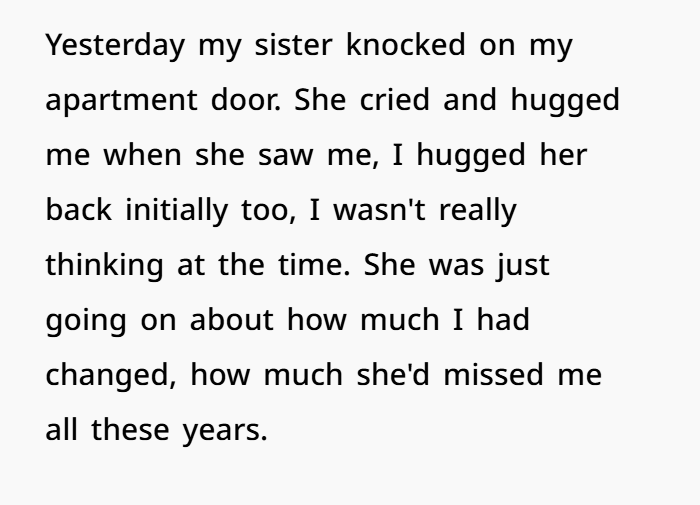
Without warning, his sister showed up at his apartment door.
She hugged him. She cried. She told him how much she had missed him.
At first, he was shocked. But once that first surprise passed, all those old feelings came rushing back.
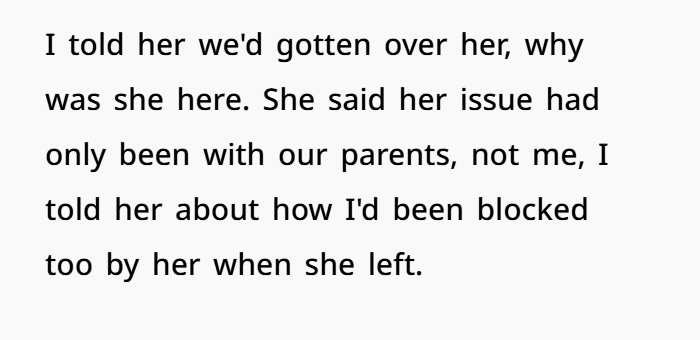
His sister explained that her problem had always been with their parents, not with him. But that was difficult to accept. After all, she had blocked him too when he tried to reach her.
Then came another surprise.
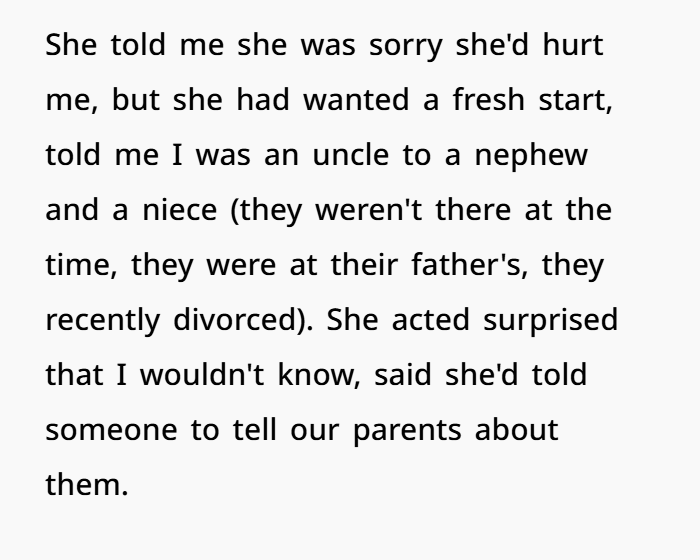
She was now a mother. During those nine years apart, she had children. That meant he had a niece and nephew he had never even met.
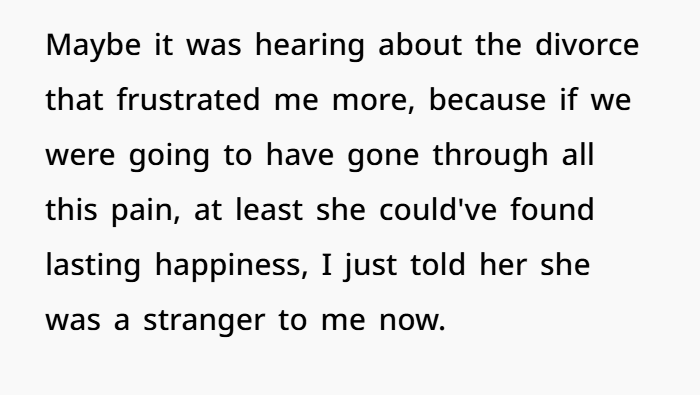
She had also recently gotten divorced.
What could have been a happy family reunion quickly became something much more painful. For him, nine years of silence couldn’t simply disappear because she had shown up at his door.
He told his sister that she felt like a stranger now.
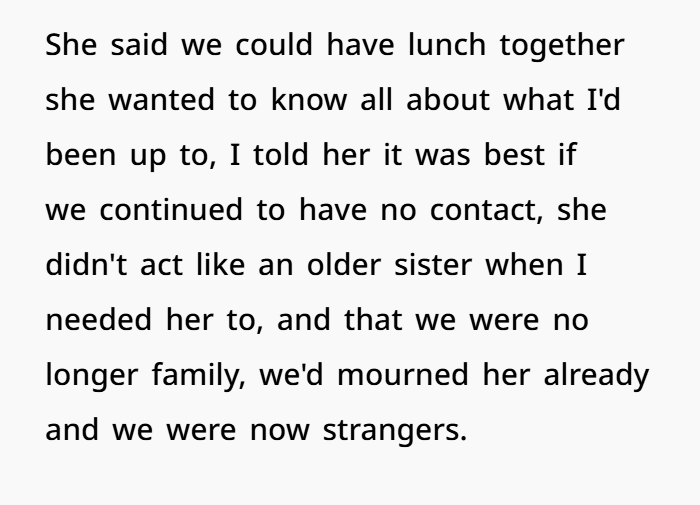
His family had already mourned losing her. They had spent years building a life without her, believing she wanted nothing to do with them.
She suggested they go out for lunch and try to reconnect.
He said no.
Instead, he asked her to keep things the way they had been and remain no-contact.
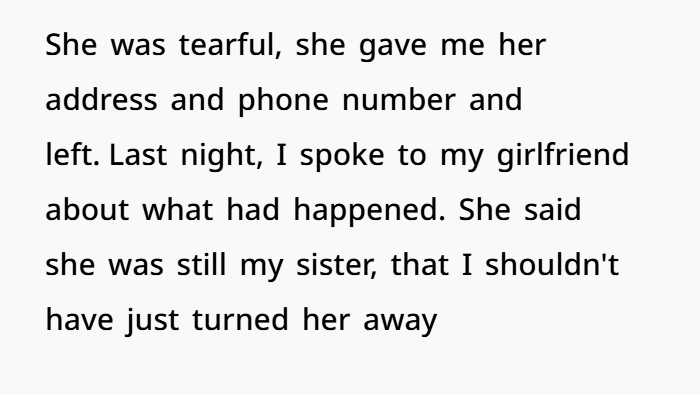
Later, his girlfriend questioned his choice. She felt that no matter what had happened, this woman was still his sister.
But that leaves a difficult question.
After nine years of complete silence, is being family enough to bring a relationship back?
Or does reconciliation take more than simply showing up again?
more info on reddit

What makes this family situation so complicated is that neither person’s choice happened on its own.
The sister may have felt that completely cutting ties with her family was the only way she could build an independent life after a serious fight with her parents. But there was another person caught in the middle: her younger brother.
From what the story says, he had not opposed her relationship. Still, she cut him off too. That meant he ended up paying an emotional price for a conflict he did not create.
That difference matters because family estrangement is much more than relatives simply losing touch over time.
The Cornell Family Estrangement & Reconciliation Project describes estrangement as a situation where relatives stop communicating, either slowly or suddenly, for a period of time. Its research estimates that 27% of Americans are currently estranged from a close family member.
So this kind of family cutoff is more common than many people may think.
Researchers have found several reasons families become estranged. These can include painful family histories, divorce, problems involving partners or in-laws, and serious disagreements about values or expectations.
In this case, the conflict also happened in an immigrant family.
For some immigrant families, marriage can mean much more than two people choosing to be together. Parents may have strong expectations about approval, culture, loyalty, and the family’s reputation. Those expectations can clash with an adult child’s desire to make their own decisions.
That does not automatically mean the parents were right. It also does not prove the daughter handled everything correctly.
We simply do not know enough.
The story does not explain exactly why her parents opposed the relationship. We also do not know everything that happened inside the family before she eloped.
What we do know is that her younger brother went through a separate loss of his own.
He tried to contact his sister, but she blocked him. He reached out through her friends and still could not get through.
Then the years started passing.
He had to deal with losing his sister while also helping his parents adjust to her disappearance. From his point of view, she did not just walk away from their parents. She also made a clear choice to remove him from her life.
That kind of experience can create something similar to what researchers call “ambiguous loss.”
Family researcher Pauline Boss developed this idea to describe a painful kind of loss where someone is physically gone but still very much present in people’s thoughts and emotions.
The person has not died. Yet they are no longer part of everyday life.
That uncertainty can make grief especially hard because there is no clear ending. Research on ambiguous loss has looked at how families can become caught between hope, sadness, and trying to move forward. Cambridge University Press research on the subject also explains how this lack of certainty can make it harder for families to deal with loss.
That gives the brother’s comment that the family had already “mourned” his sister a deeper meaning.
For nine years, there was no funeral. No final conversation. No real explanation. No clear goodbye.
She was alive somewhere, but they could not reach her.
At some point, the family had to keep living. To do that, they seem to have created their own kind of closure.
Another idea from family stress research may help explain what happened. It is called “family boundary ambiguity.”
In simple terms, it describes the confusion that can happen when people are no longer sure who is emotionally part of the family after a major absence or change.
Someone can be physically gone but still feel emotionally present. On the other hand, someone can still be alive and related by blood but no longer hold the same place in the family.
Research indexed by PubMed describes this uncertainty about who is “in” or “out” of a family as an important source of family stress.
Then, nine years later, the sister suddenly stepped back into that family boundary.
She hoped, at the very least, for a chance to rebuild the relationship.
Her brother did not want that.
This is where forgiveness and family reconciliation become two very different things.
Showing up again does not automatically bring back closeness.
They never stopped being brother and sister by blood. But the sibling relationship they once had stopped functioning years ago.
She missed the years when he went from an 18-year-old teenager to a 27-year-old adult.
He missed her marriage, pregnancies, motherhood, and later her divorce.
They share a past, but that does not mean they still know each other’s lives.
Research suggests that reconciliation after family estrangement can happen. But it usually works more like a process than a switch that can simply be turned back on.
Cornell’s Family Estrangement & Reconciliation Project studies families that have started speaking again after periods of estrangement. The goal is to better understand how damaged family relationships can be rebuilt.
Other research on estrangement and reconciliation has also looked at things like attachment and family circumstances. Renewed contact is not treated as something that automatically happens just because one person comes back.
That makes the sister’s surprise visit especially important.
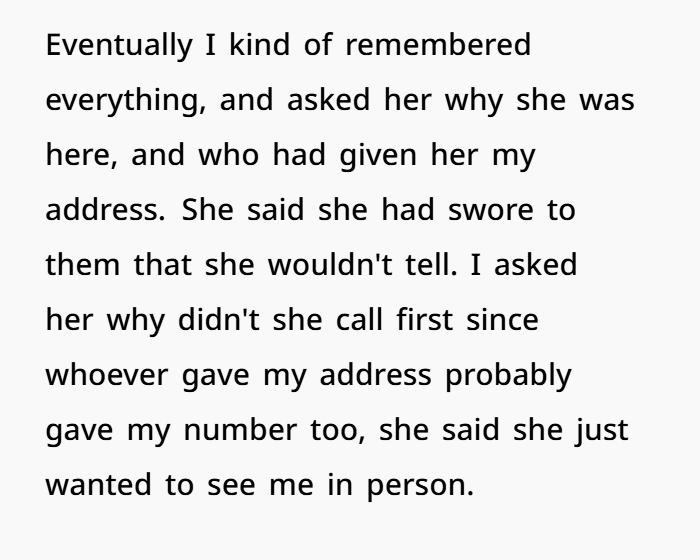
According to the story, she got her brother’s home address from someone who promised not to reveal who they were. Then she showed up without calling him first.
Her reason may have been emotional. Maybe she thought seeing him face-to-face would show that she was serious about making things right.
But from his side, it could have felt very different.
He had no chance to decide whether he was ready to see her before she was standing at his home.
Wanting reconciliation does not erase another person’s boundaries.
A less intrusive first step could have been a letter, text, email, or phone call. She could have acknowledged the nine years apart and then allowed him to decide whether he wanted to respond.
Advice around rebuilding estranged family relationships often focuses on clear boundaries and taking things slowly. In some cases, family therapy or relationship counseling may also help, especially when the original problems have never been resolved.
TIME has also discussed reconciliation with estranged relatives in this way. Rebuilding a relationship may involve therapy, boundaries, and slow or conditional contact instead of immediately acting as though everything has returned to normal.
Then there is another painful part of this story: the divorce.
Finding out that his sister’s marriage had ended seems to have made the brother even more upset.
In his mind, that marriage may have become connected to everything the family lost. There had been nine years of grief, conflict, emotional pain, and estrangement.
Learning that the marriage eventually ended may have made all of that pain feel pointless to him.
That reaction is understandable. But it is not necessarily fair.
A marriage ending in divorce does not mean the years before it were meaningless or unhappy. It also does not prove that choosing to elope was a mistake.
People can make a genuine choice about who they want to marry and still get divorced years later.
There is also an important difference between her choice of partner and her choice to cut off her brother.
Choosing who to marry was about her own freedom and independence.
Cutting off her brother affected someone else, especially someone who says he had supported her right to make that choice.
At the same time, the fact that she returned after her divorce does not prove she only came back because her marriage failed.
There could be many reasons.
Maybe a major life change made her think differently about family. Maybe she wanted her children to know their relatives. She may have regretted cutting everyone off. Or perhaps nine years simply began to feel like too long.
The story does not tell us her real reason, so we cannot know for sure.
And even if she truly regrets what happened, regret and reconciliation are not the same thing.
An apology can recognize the hurt someone caused. Rebuilding trust takes much more.
It can take time, consistency, responsibility, and effort. Most importantly, both people have to want to rebuild the relationship.
The sister has every right to ask for another chance.
Her brother also has the right to say he is not ready to give her one. He may never be ready.
That does not mean either person has to become the villain of the story.
There is, however, one strong argument against making a final decision based only on what happened at the door.
The brother was under huge emotional pressure.
Someone he had spent almost a decade learning to live without suddenly appeared in front of him. He had only minutes to process what was happening.
He called her a stranger and rejected the idea of having a relationship with her again.
Maybe that is exactly how he will still feel months or years later. But it is also worth remembering that he said those things while dealing with the shock of seeing her again for the first time in nine years.
The phone number and address she left behind change things a little.
He no longer has to make a decision in that emotional moment.
If he ever wants answers, he now has a way to contact her on his own terms. If he does not want contact, having her information does not mean he has to use it.
His girlfriend’s argument that she is “still his sister” gets to the heart of the problem, but it does not solve it.
Blood makes them family.
It cannot recreate trust, emotional closeness, or nine missing years.
So perhaps the bigger question is not whether he was wrong to turn her away that day.
The real question is whether that boundary is still what he wants once the shock has faded.
If it is, staying no contact may be what he needs.
But if part of him still wants to understand why his sister disappeared, reconnecting does not have to mean forgetting everything that happened.
It could start with one conversation.
It could come with strict boundaries. It could even involve professional family counseling before any larger reunion takes place.
After nine years apart, these siblings cannot simply return to the relationship they once had.
That version of their relationship is gone.
If they ever choose to become part of each other’s lives again, they would have to build something new.
And this time, both of them would have to choose it.
Here’s what people had to say to OP: